Property and infrastructure assurance Energy software and research Queensland, Australia
Know the systems you rely on are telling the truth.
Cloudsail makes new and existing technology more intelligent. Our lead product, Arthur, monitors property and infrastructure and keeps the evidence behind every assessment, before, during and after an event. We also build energy software, and run energy research, for sites with solar.
NewsCloudsail is a finalist in the 2026 Innovate with nbn® Grants Program, in the Innovation for Productivity category, for Arthur.
Read the announcement →01 Arthur Property and infrastructure assurance
Evidence you can check, before, during and after an event.
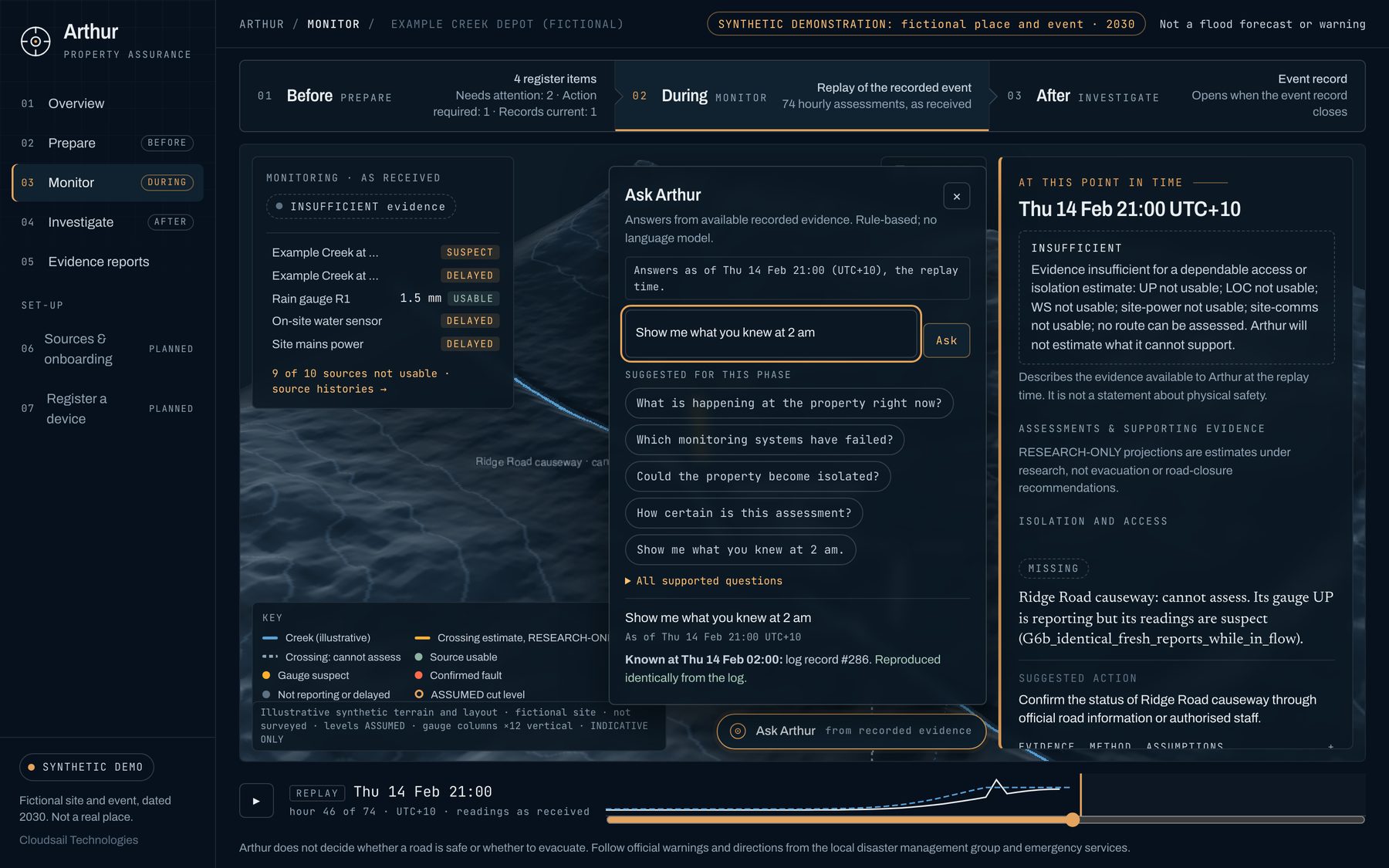
Arthur is a continuous model that monitors your infrastructure and alerts you when something goes wrong. It checks whether each camera, gauge and sensor is usable for the assessment at hand, says when the evidence is not enough, and keeps a signed record of what it knew and when.
Before
Prepare and inspect
What is at risk, and what to fix before the season, from the site's own inspection records.
Before an event →During
Monitor and anticipate
Which sources are working, what has failed, and whether the evidence supports an assessment.
During an event →After
Investigate and verify
What happened, what Arthur knew at the time, and a signed report anyone can check.
After an event →Working demonstration on synthetic data. Finalist, 2026 Innovate with nbn® Grants Program, Innovation for Productivity. Participant, CSIRO Innovate to Grow 2026, Digital Technologies & AI.
02 More from Cloudsail
Energy Software and research
Run more of your site on its own solar.
The Renewables Operating System is a working software prototype. From imported or synthetic data, it builds a schedule that moves flexible electrical work into the hours your solar is producing, inside your grid connection limit. DemandProof and FlexTwin are research and development projects on measuring and modelling energy flexibility.
Energy software and research
Interactive Original game in pre-production
Palace of Tides.
An original Australian game set between a French Baroque palace and the Great Barrier Reef. Its multiplayer round engine is built and tested. The same disciplines run through Arthur: systems that agree on what happened, and simulations held to a specification.
Palace of Tides03 The problem
The system says one thing. The site says another.
Your camera says
Online. But is the picture still changing?
An uptime check confirms a camera answers. It does not confirm the picture is current. A feed can report online long after its picture stopped updating.
Arthur checks the picture, not the connection.
Your flexibility report says
Load shifted. Nobody can check the number.
A saving is measured against what the site would have used anyway, which never happened. If that estimate is wrong, every figure built on it is wrong too.
DemandProof puts an uncertainty band on the estimate, independently, and refuses when the data falls short.
04 In practice
What the system saw. What we checked. What you get.
- ArthurSynthetic demonstration
Mains power lost. The site hub stops reporting. Five hub-dependent sources go quiet.
Is there still enough evidence to estimate whether the depot can be reached? No.
No estimate. The reason stated, the shared cause traced, the record kept.
- Renewables OSSimulated sample site
Hot water heating set for 05:00, before sunrise.
Can it wait for solar and still meet its deadline and the grid limit? Yes.
Moved to 09:00. About 90 kWh less from the grid in simulation, reason logged.
- DemandProofPrototype, example data
A saving claimed for a demand-response event.
Is there enough data to estimate what the site would have used? Not enough like days.
No number, a coded reason instead. Nothing to defend later.
Built with AI, run on proven maths: statistical models, optimisation and digital twins. Every answer is checked and sourced: click any figure in our software to see where it came from, when, and how it was worked out. You stay in charge. When an input fails, you are told, instead of the answer quietly going wrong.
05 By situation
Built for places that are hard to get to.
- A
Councils and asset owners with camera networks
Flood points, depots, pumps and bridges. Dozens of feeds, and no way to know which ones are really working.
Arthur is designed to show which cameras and gauges are usable, and to keep the record of what was known and when, for the review after the event.
- B
Remote and regional properties
Homes, holiday rentals, farms and stations with nobody on site when the weather turns. A week of footage is not an answer.
Arthur is designed to tell you what is happening, which systems have stopped, and what happened while you were away.
- C
Industrial sites with solar
Pumps, cold stores, compressors and chargers running on the grid while the roof is producing.
The Renewables Operating System is designed to move that work into the solar window inside your grid connection limit, without touching essential loads.
- D
Energy teams who need numbers they can defend
An energy number has to survive a question from finance, an auditor or the company paying you.
DemandProof gives you the estimate, its uncertainty band, and a coded reason whenever it holds a number back, independent of who gets paid on it.
06 Energy software and research
Energy software and research for sites and homes with solar.
The Renewables Operating System and TropicFlex schedule work into solar hours. DemandProof and FlexTwin EdgeHub are research and development projects, shown here at their current stage.
Renewables OS
Renewables Operating System
Solar scheduling software
Schedules flexible electrical work into the hours your own solar is producing, inside limits you set.
How it schedules →DemandProof
DemandProof
Flexibility measurement you can check
An estimate of what the site would have used, an uncertainty band around it, and a number held back when the data cannot support one. Independent of who gets paid on it. Experimental prototype.
Numbers you can check →FlexTwin EdgeHub
FlexTwin EdgeHub
On-site digital twin of your building
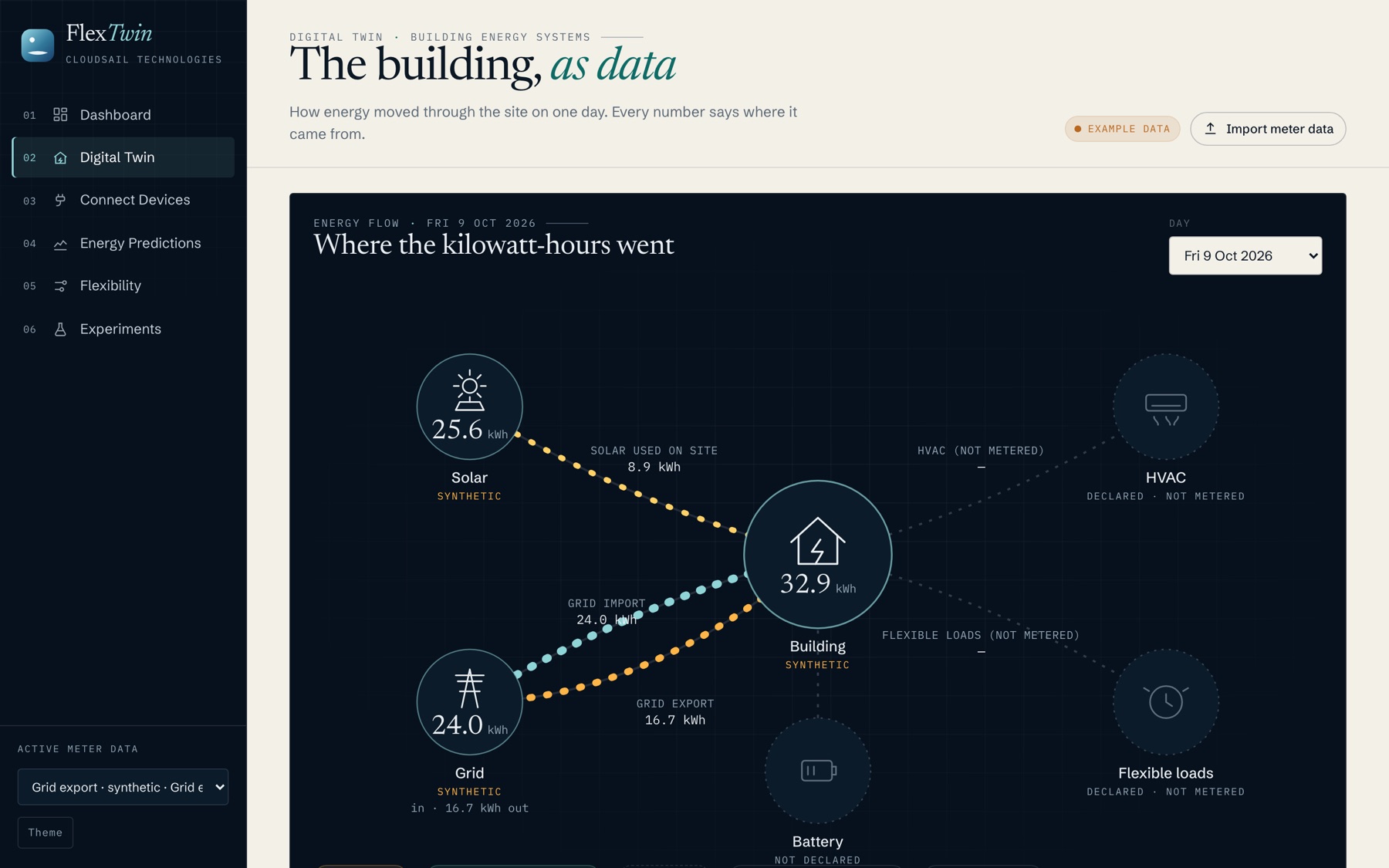
A digital twin of your building, designed to run on site. Shows where every kilowatt-hour went, forecasts tomorrow and recommends when loads could move. Laboratory prototype, advisory only.
The building as data →TropicFlex
TropicFlex
Home air-con on solar, without the damp
Simulation research into moving a home's split-system air-con into its solar hours, inside comfort and humidity limits.
Cooling on solar →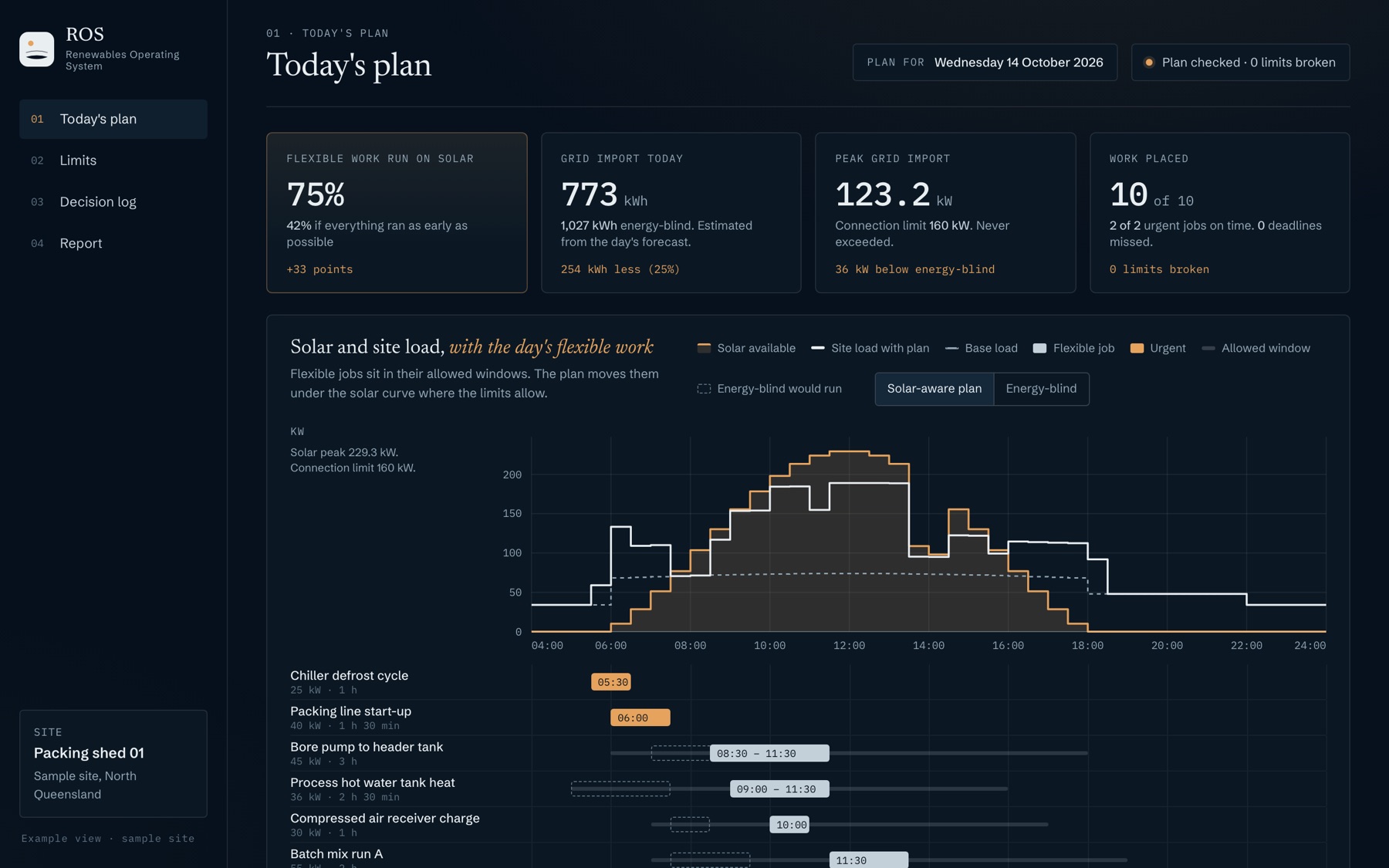
07 How we work with you
You see the reason. You stay in control.
- 01
Every finding shows its evidence
Each statement opens to its sources, method and assumptions, so you can check it, and so can anyone you report to.
- 02
Nothing is switched without your rules
You set the limits. Loads are designed to move only inside them, and urgent work is never delayed. Built to work with the cameras, meters and controls already on site, so there is nothing to rip out.
- 03
Results you can defend
Pass criteria are set before we test. Results are sourced. Every claim we make to you is backed by a recorded result.
08 What working with us looks like
Small, time-boxed, scope agreed up front.
- 1
Scoping call
Agree what to watch or shift
Which cameras, loads or meters. What counts as a pass. How long it runs. Written down before anything starts.
- 2
Connect
Use what is already on site
Your existing cameras, meters or controls. No new hardware to start.
- 3
Run
A fixed period, in the open
For the agreed period, every finding and every schedule is shown with the reason behind it.
- 4
Review
A written report you keep
What was found, what was shifted, and the recorded results behind each figure. Measured against the pass criteria we agreed.
09 Questions
What you need, and what you get.
What do I need to have?
Cameras, meters or controls that are already on site, and a way for our software to reach them. For Arthur, cameras we can read a feed from. For Energy, solar and loads that can move. We confirm the details for your site during scoping.
Does it work with my cameras or my solar?
Arthur is designed to read the feed from the cameras you already have, and the Renewables Operating System to work with the meters and controls on site. Every site is different, so we confirm this for your site during scoping, before anything is connected.
What does working with you involve?
A scoping call to agree what to watch or shift, what counts as a pass and how long it runs. Then we connect to what is already on site, run for the agreed period in the open, and give you a written report you keep. Small and time-boxed. The scope is agreed up front.
Does it work outside Australia?
Yes. Arthur works with standard camera feeds, and the energy software works from interval meter data and weather, which every market has. The DemandProof prototype reports ASHRAE Guideline 14 reference metrics, the measurement and verification reference widely used in North America. We confirm what your site needs during scoping.
Where is my data kept?
We agree where your footage and data are kept, and who can see them, in writing before anything is connected. We confirm this for your site during scoping.
Who is behind Cloudsail?
Cloudsail Technologies Pty Ltd, ABN 63 615 833 782, an Australian company established in Cairns, Queensland in 2016. Its founders and directors are Virginia Graham and Phil Riches. Arthur was accepted into CSIRO Innovate to Grow in 2026.
What is Cloudsail's connection with CSIRO?
Cloudsail is a participant in CSIRO's Innovate to Grow 2026 program, in the Digital Technologies & AI stream, for Arthur. Participation does not mean CSIRO has reviewed, certified or endorsed any Cloudsail product.
Is Arthur in use at a site today?
Not yet. The full BEFORE, DURING and AFTER application runs as a working demonstration on synthetic data, and a first pilot will connect it to a real site.
10 Talk to us
Talk to us.
Request an Arthur demonstration, discuss a scoped pilot for a council or property, explore a technical or research collaboration, or ask about our energy and interactive work. We reply within two business days.
Cloudsail Technologies Pty Ltd · ABN 63 615 833 782
Queensland, Australia. Remote and regional Australia first.